**The transferring facility is not required to change or issue routing to aircraft if it is satisfactory to the first fix in the receiving facility's airspace.
## The transferring facility is not required to change or issue routing to aircraft if it is satisfactory to the first fix in the receiving facility's airspace.
**Minimum radar separation on all aircraft shall be five (5) NM, constant or increasing, at the time of handoff.
## Minimum radar separation on all aircraft shall be 5nm, constant or increasing, at the time of handoff.
**Radar hand-offs shall be made in relation to the adjacent ARTCC/ATCT boundary. The adjacent boundary shall be defined as the transfer of control point.
## Radar hand-offs shall be made in relation to the adjacent ARTCC/ATCT boundary. The adjacent boundary shall be defined as the transfer of control point.
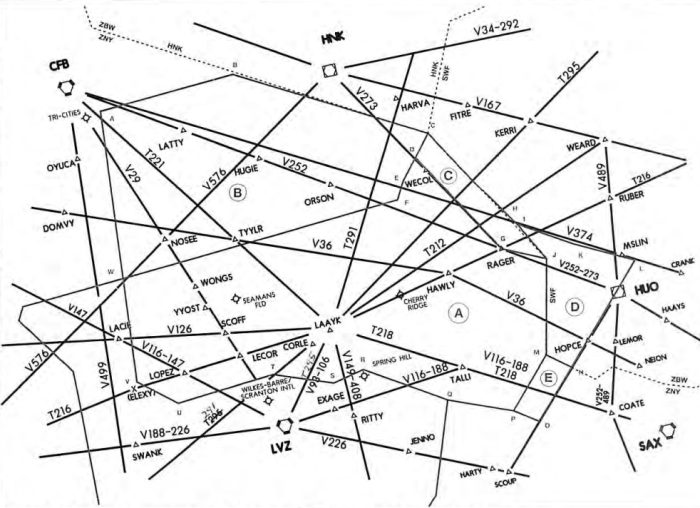
**Wilkes-Barre airspace that overlies Binghamton airspace (section B in attachment 1 at 9,000 and 10,000 feet) will revert to New York ARTCC under the following conditions, when Binghamton ATCT closes on the mid shift or loses radar capability.
## Wilkes-Barre airspace that overlies Binghamton airspace (section B in attachment 1 at 9,000' and 10,000') will revert to New York ARTCC when Binghamton ATCT closes on the mid shift or loses radar capability.
*Departures/Arrivals:
# Departures/Arrivals:
**Catskill area departures and arrivals shall be handled as follows:
## Catskill area departures and arrivals shall be handled as follows:
***When traffic conditions warrant, non-turbojet departures, requesting above 10,000 feet, may be assigned 10,000 feet and handed off to Wilkes-Barre ATCT. When this option is exercised, Stewart sector shall ensure that 10,000 feet is entered into assigned altitude field of the flight plan.
### When traffic conditions warrant, non-turbojet departures requesting above 10,000' may be assigned 10,000' and handed off to Wilkes-Barre ATCT. When this option is exercised, Stewart sector shall ensure that 10,000' is entered into assigned altitude field of the flight plan.
***Arrivals to MSV and N37 airports shall be routed via LAAYK T295 PRNCE V34 FILPS or the FIXES of this route and cross the Boston ARTCC boundary at or below 9,000 descending to 7,000 feet.
### Arrivals to MSV and N37 airports shall be routed via LAAYK T295 PRNCE V34 FILPS or the fixes of this route and cross the Boston ARTCC boundary at or below 9,000' descending to 7,000'.
***All other arrivals shall be routed via LAAYK T295 PRNCE V34 FILPS or the fixes of this route and cross the Boston ARTCC boundary at or below 11,000 descending to 9,000 feet.
### All other arrivals shall be routed via LAAYK T295 PRNCE V34 FILPS or the fixes of this route and cross the Boston ARTCC boundary at or below 11,000' descending to 9,000'.
;Attachment 1 Terminal Control Airspace
=== Attachment 1 - Terminal Control Airspace ===
[[File:Airspace-AVP-ZBW|700px]]
<showhide title="Terminal Control Airspace Map" default-visible>
This agreement prescribes transfer of control procedures, radar handoff procedures, route/altitude assignments, and delegation of airspace between Boston ARTCC (ZBW) and Wilkes Barre TRACON (AVP).
Scope
The procedures contained herein must apply unless prior coordination is effected.
Disclosure
vZNY and any other facilities mentioned in this document are affiliated with the Virtual Air Traffic Simulation (VATSIM) network. The procedures outlined in this document are intended exclusively for use in the VATSIM flight simulation environment and must never be used for actual flight or air traffic control operations. vZNY and any other facility mentioned in this document are not affiliated with the FAA in any manner.
General Procedures
Transfer of Control Procedures:
The transferring facility is not required to change or issue routing to aircraft if it is satisfactory to the first fix in the receiving facility's airspace.
Minimum radar separation on all aircraft shall be 5nm, constant or increasing, at the time of handoff.
Radar hand-offs shall be made in relation to the adjacent ARTCC/ATCT boundary. The adjacent boundary shall be defined as the transfer of control point.
Wilkes-Barre airspace that overlies Binghamton airspace (section B in attachment 1 at 9,000' and 10,000') will revert to New York ARTCC when Binghamton ATCT closes on the mid shift or loses radar capability.
Departures/Arrivals:
Catskill area departures and arrivals shall be handled as follows:
When traffic conditions warrant, non-turbojet departures requesting above 10,000' may be assigned 10,000' and handed off to Wilkes-Barre ATCT. When this option is exercised, Stewart sector shall ensure that 10,000' is entered into assigned altitude field of the flight plan.
Arrivals to MSV and N37 airports shall be routed via LAAYK T295 PRNCE V34 FILPS or the fixes of this route and cross the Boston ARTCC boundary at or below 9,000' descending to 7,000'.
All other arrivals shall be routed via LAAYK T295 PRNCE V34 FILPS or the fixes of this route and cross the Boston ARTCC boundary at or below 11,000' descending to 9,000'.